I’ve slammed into a creative wall. Call it gear acquisition syndrome (GAS), boredom, or a genuine artistic barrier — whatever it is, the fact is that my creative barrier has become so high that I NEED to change my choice of camera body, format and maybe even the system! I’m ready to dump it all and go Fujifilm! Where’s that camera gear trade in site… MPB… KEH… ?!?!?
I almost traded all of my camera gear to start over in 2025. Fortunately, that didn’t happen. My wife and the analytical side of me talked my creative side off the ledge. It is true that I do have a creative problem that I want to solve. I really enjoy photography and shooting video, but for whatever reason I’ve got a creative block that has conflicting priorities. Since my day job is helping companies develop their technology strategies, I’ve brought my work approach into my personal life to solve this problem. I need a clear use case to guide me so I don’t make a stupid, regrettable and likely expensive mistake.
Looking for Leading Practice
I’ve stumbled across numerous threads and posts where someone asks “what digital camera and lens combination should I get” and the response is “what’s your use case?” Inevitably, the conversation pivots to what the person wants to shoot, which is leading practice: landscape, portrait, wildlife, family, sports, street — or by another term, the Big 6. Toss in video and things get a bit more interesting, but settle quickly around the Big 6, too. Budget questions are raised but in the end, most answers point to popular combinations of popular cameras with popular lenses starting at full frame with arguments for/against APS-C and Micro 4/3. The reality is that leading practice covers 80-90% of typical photographic requirements.
Good consulting involves research, but I quickly found that the popular digital ink around photographic leading practice that’s splashed across the internet isn’t all that helpful. True leading practice is difficult to uncover because there’s too much emphasis on features, specs and brand elevation, and not enough on how people can use what they have to tackle imaging challenges. Frankly, I find myself using a friend’s technique when he watched future horror TV shows — he turned it off at the first sign of goo. Similarly, I stop paying attention to a review, video or post when goo surfaces — someone complaining about the lack of a joystick, something Canon has that the other brand doesn’t, the need for yet another custom function button or a diatribe about resolution without a firm grasp on math. Click. I’m out.
Complaining (which is different from constructive criticism) isn’t helpful and is why I discounted the perspectives of and drifted away from many photographic and video experts for this exercise that have been around for years — Ken Rockwell, Chris Niccolls & Jordan Drake, Philip Bloom, Chelsea & Tony Northrup, etc. — because their perspectives as of late often descend into opaque rants, tired complaints (“It would be better if it had ____ like a ____”) or express curmudgeon-like bias (“Image quality of ____ is good, but not up to par with a Leica ____”). Every camera doesn’t need to work like a Canon and Leica gear isn’t perfect. Different companies prioritize different features and functionalities to get a slice of a fickle audience. Case in point, since the days of film Canon cameras and lenses are uninspiring to me, so elevating Canon generally triggers the opposite reaction. If it isn’t like a Canon then it has to be good.
Anyhow, people like Gerald Undone, Dustin Abbott, Cam Mackey, and other practicing creative photographers and cinematographers who share their professional experiences help us understand limitations and how to translate them into creative advantages. They complain too, but often don’t become single-minded. They tend to be more open to expressing possibilities and potentials in a piece of gear, rather than focusing on some minor, irrelevant comparison with a favored brand. As such, their experiences are more valuable to me, so I’ve turned to their perspectives to supplement my use case research.
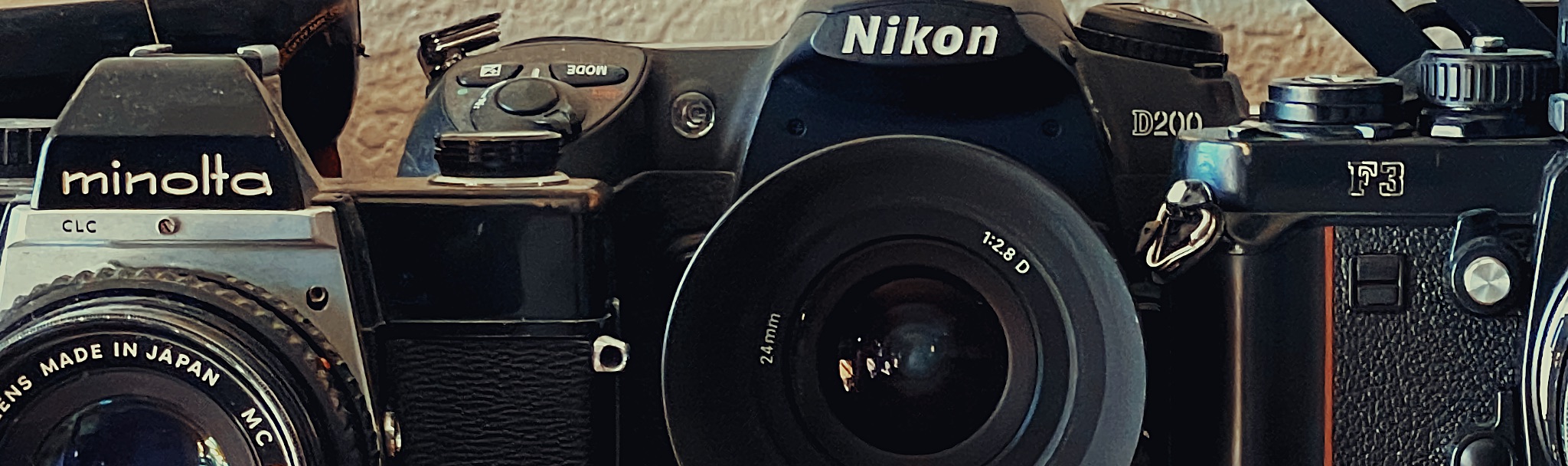
Consulting starts with context, so here’s mine. I began with sports and street photography in the 1980s (Minolta SRT-201 and Nikon N2000, FE2 and F3); studied broadcast video production with a diversion into photography at Loyola New Orleans where I did my own darkroom work around that time; jumped to scanned images and Photoshop (v1) in the early 1990s; started my shift from film to digital beginning with access to a smattering of compact all-in-one digital cameras (Sony DSCs D & F series, Nikon Coolpix, Kyocera Finecam, Apple QuickTake 100, etc.) and Nikon D1, Canon 5DmkII, Canon 1D, and Kodak DCS Pro 14n DSLRs. In the early 2010s, I made the personal move from a Nikon D200 to Micro 4/3 with Panasonic G/GH and Olympus PEN bodies that incorporated HD video; and tried a Sony NEX-5 (APS-C) and a used full frame A7.
My style evolved from manual focus fast action of hockey and basketball to telephoto urban street photography using a combination of vintage and autofocus lenses. Autofocus was never a priority because autofocus-of-the-era slowed me down. As a result, I leaned in hard on rapid manual focus and street style with vintage glass. Around that time, I was limited by the dearth of quality wide angle options for a smaller frame, which led me to use my iPhone a bit more. I started doing some nature work (we lived near a marine sanctuary, so back to telephoto) and my style slid more into dusk and night photography. When I picked up the Sony A7, I assumed I’d stick with full frame — leading practice dictated that I should.
I didn’t.
Around that time, body + lens combinations of digital cameras were out of control. The weight and size of my A7 with lens rivaled my Nikon F3 with its Action Finder and big, fast glass. Traveling around Japan with an A7 and a bulky cinematic-feel standard zoom made me swear off full frame. Although I loved the image quality of the glass, I longed for something that fit in a backpack and didn’t wear out my shoulder. The A7 kit was too big and too heavy. I missed my Micro 4/3 gear, but didn’t miss the average image quality from the sensors of the time. By that point, I didn’t have the time to process my images to make up for sensor size and sensitivity, so what came out is what I used. That’s my style.
The final full frame blow came when I visited a Sony corporate boutique in Tokyo. Seeing the product lineup in person, I became disenchanted with the imaging group’s strategic direction. The company known for miniaturization showed no signs of creating compact lenses; design was getting bigger. I struggled with the whole idea of mirrorless photography at that point — how could Leica, Cosina and vintage lens makers who worked with slide rules come up with small designs in the 20th century, but 21st century engineers could not? That was a problem that didn’t seem to have an answer.
A Decade Later
Today, I shoot with a Sony A6600 and a variety of vintage, rehoused and unique lenses, and autofocus zooms and primes. Two things changed that impacted my rather unfocused use case from a 10 years earlier:
- Autofocus is accurate enough to enable me to frame and focus at the same mental speed as I did on film. Don’t get me wrong, autofocus has been fantastic for a long time, but my old habits and shooting style got into my own photographic way. I can’t explain it, but autofocus and I didn’t get along until the A6600.
- Third-party autofocus adapters actually work and work well. Although I had a horrid experience with a Techart Contax G autofocus adapter that nearly destroyed its attached lens, its Sony E to M autofocus unit works great. I can (and do) shoot with my vintage glass using autofocus. Once I rehoused my copy of a Contax 45mm f/2 G lens into a Funleader M lens housing, I could use it as a quick-ish street lens. While not as great as a fully dedicated modern optic, the way focus works coupled with its vintage characteristics align to my ancient indescribable photographic approach.
Like everyone who seems to ask on blogs and forums today, my base use case spans the Big 6. Where I deviate is that I love to manipulate my shot framing to capture the “character” (imperfections) of vintage lenses with tuned in-camera picture profiles. That practice provides me with more of a film-like baked-in image and reduces a rapid-fire, fix it in software task later.
Unfortunately, APS-C crops out the frame edges and turns my 45mm into a nearly 70mm telephoto that eliminates some of the uniqueness of that lens. My very vintage collapsible Leica 50mm becomes a flat 75mm telephoto. If I want wider, I can shoot with something like a 20mm or 24mm, but the inherent distortion these lenses bring to my work is unappealing. I shoot with a manual focus 35mm 1.6x anamorphic to flatten the field of view instead. I’ve got an autofocus 15mm, which works great, but sometimes I want the character of a vintage 50mm and I simply can’t capture the entire look in APS-C.
Back to standard full frame?
The problem with pivoting to standard 24-33MP full frame is lens bulk once again, especially for travel and street photography. When I lived in Chicago and shot Micro 4/3, I loved being able to use my Contax G 90mm as a 180mm telephoto or a Voigtlander 40mm as an 80mm. But if something happened near me, forget it; I’d get a closeup of someone’s shoulder.
Full frame provides access to “typical” vintage glass in “typical” photographic scenarios, but autofocus telephoto becomes monstrous once more. I’ve hiked around Kilauea with a full frame 100-400mm zoom and it sucked, especially when I needed to swap to something a bit more people friendly. Additionally, changing lenses around an active volcano isn’t cool. I took a lot of shots with my iPhone because changing lenses was a pain (and risky). I generally don’t care for the iPhone’s synthetic quality, but the camera you have is better than the one you don’t. I shot more Hipstamatic than actual camera for several years.
Maybe a second body?
If I was a pro, I’d definitely split formats but honestly, I don’t want to be THAT amateur all of the time. I want to learn one body and continue to make it an extension of me, and not dither in the field switching cameras. I’m not a pro that has to get the shot; I’m a creative amateur who will work with what I’ve set out to use that hour, day or trip. I became a one camera person while using my Lumix G1, GH2 and GH3 cameras. I left my Nikon D200 on the shelf, which enabled me to get into a Micro 4/3 headspace and envision my shot before I captured it. I’m practically there with the A6600, especially now that I can think ahead of the autofocus to get what I want. That kind of symbiosis only comes through constant shooting with a core set of gear and not overthinking camera A or camera B for this shot.
If I did go with a second body, it’d have to be a combination of Micro 4/3 plus either full frame or medium format, which brings me to sensor size vs. pixel density. For how I shoot, 24-26MP is plenty, however under 20MP is a problem. I shot a lot of 12-16MP images and they have issues, from pixelation to banding, so cropping a 24MP (or even 33MP) full frame image to give me an APS-C frame isn’t in the cards. Many of today’s Fujifilm’s APC sensors are 45MP, which is fantastic, but the APS-C crop kills the character of vintage glass once again. Software scaling is an option, but I’m a retro capture-it-in-frame kind of guy who is trying to avoid “fixing it in post” as much as possible.
What about digital medium format?
The price is certainly high — even used. Although I really want a Hasselblad X2D, at this point GFX cameras from Fujifilm are the only viable options for capturing the full frame character of my glass at an approachable price. Unfortunately, the older 50MP cameras have technical issues that limit their use into the future; I’d have to go to a 100MP body to limit going too far backwards in performance. Upside of that is the current generation of cameras support greater than 8-bit compressed images (I don’t have the time nor patience for RAW). A 10- or 12-bit HEIC format image is ideal for me and how I manage my workflow.
If I go the GFX route, I run into an old problem — autofocus and lens size. My vintage lenses lose my newfound autofocus functionality, which isn’t exactly a deal breaker, but still a disappointment. Any medium format glass is both expensive and large, so I have to take that into account. Finally, shooting anamorphic, which I enjoy, becomes very expensive as most options are limited to a cinema PL mount.
We live in a great time with too many options, which brings me back to Sony. Both Sony and third-party lenses are becoming smaller again because of Sony’s shift to in-body stabilization, so what I experienced in Tokyo is starting to melt away. That leaves four options: A1, A7RIV, A7RV, and the A7CR. Since the A7RIV doesn’t support HEIC, I’m knocking it out because bit depth matters. The A1 is simply too expensive for what it is and what I shoot, which leaves the A7RV and A7CR.
On both the A7RV and A7CR, an APS crop offers a 26MP image, which is better than my A6600. That simple in-camera resolution reality gives me the option to “punch in” without losing expected pixels. The sensor is full frame, so when I’m traveling or shooting street, I can capture both wide and telephoto with one prime. I can still use my E to M autofocus adapter, too, and auto focus is familiar. All told, my investment in lenses isn’t a loss.
Budget aside, which body should I choose? Sony product marketing’s feature list pushes me to the A7RV but when I had the A7, I found that I no longer liked SLR-style ergonomics. Smashing my nose onto a view screen when I needed to use the viewfinder just doesn’t work for me anymore. In fact, I have become used to rangefinder style shooting through several Sony DXC-series cameras, and Olympus Micro 4/3 and Sony A6xxx bodies. Additionally, I missed the spin and flip screen of the Lumix G cameras. Having a monitor that can swivel to accommodate different shooting angles is creatively refreshing. The Luddite photographer in me is starting to slink away.
The Use Case
Getting to this point has taken a year. As I noted at the beginning, I considered tossing in the towel and going all in on a Fujifilm X-H2 but logic prevailed. I shoot the Big 6 but can switch between any of them at any time.
My use case centers on being able to shoot the Big 6 with consistent image quality and lens character based on my creative intent and situation. Changing brands to have the same frame size but different color science and more megapixels doesn’t fix my creative problem. The alternative of “going medium” creates new and costly problems. Admittedly, researching the Hasselblad X2D did put the nail in the coffin for any desire to have a Leica digital M body and really reduced my interest in a GFX 100s. For me, the experience of shooting is more than technical and for that, my unobtainium camera might be an X-series Hasselblad.
After all my research, deliberations, and spec diving, I’ve decided that the A7CR is the best match for my use case. It is time to buy the Sony A7CR … and rent a Hasselblad.